
Exercise for Weight Loss: Cardio vs. Strength Training - What Actually Works
 Jan, 14 2026
When it comes to losing weight, most people assume the answer is simple: do more cardio. Run longer, cycle harder, burn more calories on the treadmill. But what if the scale isn’t moving - even after months of running? And what if your clothes are fitting better, but the number on the scale hasn’t changed at all? That’s not a failure. It’s your body doing exactly what it’s supposed to do.
Cardio Burns Calories While You’re Doing It - But That’s Only Half the Story
Cardiovascular exercise - running, swimming, cycling, brisk walking - is great at burning calories right now. A 155-pound person jogging for 30 minutes burns around 300-400 calories. Cycling at a moderate pace? 250-600. Swimming laps? 200-500. That’s a lot of energy spent in under an hour.
But here’s the catch: your body adapts. After 8-12 weeks of steady cardio, your efficiency improves. You burn fewer calories doing the same workout. That’s why so many people hit a plateau. They keep running the same route, same pace, same duration - and the scale stops moving. It’s not laziness. It’s biology.
Cardio also doesn’t protect your muscle. In fact, long hours of steady-state cardio without strength work can lead to muscle loss, especially if you’re not eating enough protein. Losing muscle slows your metabolism over time. That’s why some people lose weight but look thinner, not tighter. They’re losing muscle along with fat.
Strength Training Doesn’t Burn Much During the Workout - But It Changes Your Body Forever
Thirty minutes of weight training? You’ll burn maybe 90-150 calories. That’s less than half of what you’d burn jogging. So why do so many people who lift weights lose fat even when they don’t run?
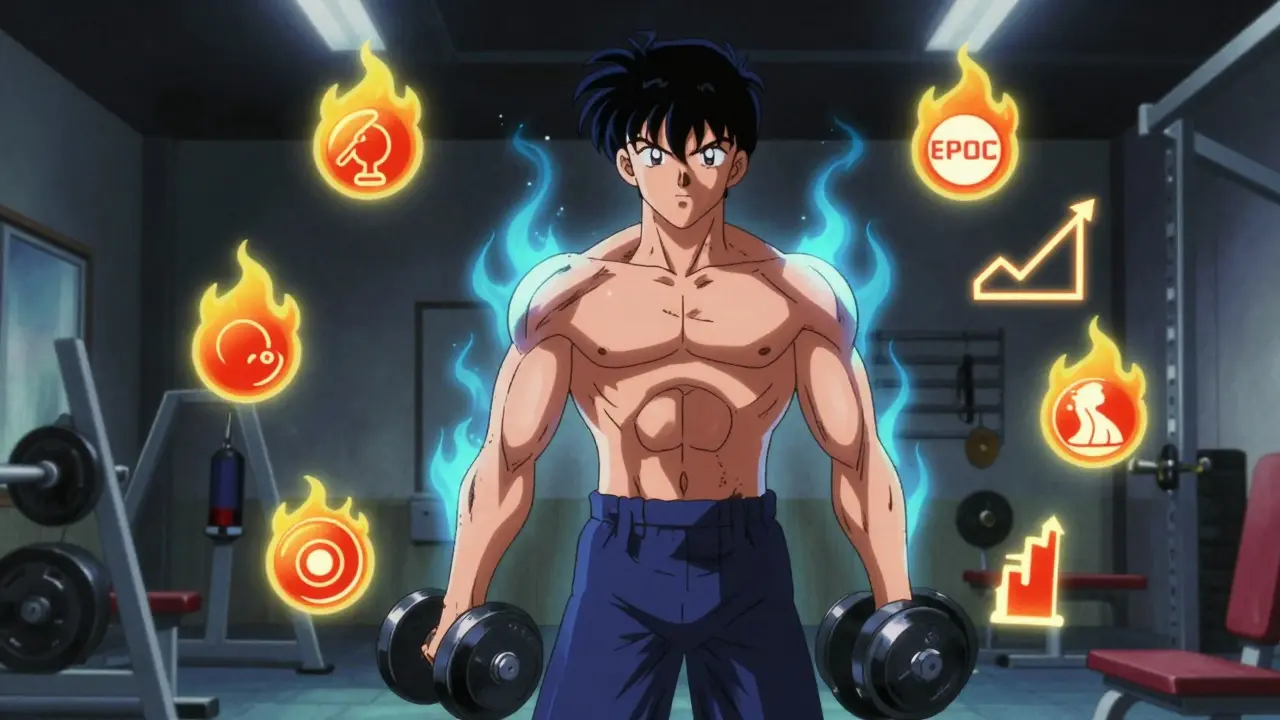
The answer is in what happens after you finish. Strength training triggers something called excess post-exercise oxygen consumption, or EPOC. Your body keeps burning calories for up to 48 hours after your workout as it repairs muscle tissue and restores oxygen levels. One study found that intense strength sessions can boost metabolism for two full days.
And here’s the real game-changer: muscle burns more calories at rest than fat. Every kilogram of muscle uses 13-15 calories a day just to exist. Fat? Only 4.5-5. That means if you gain 2kg of muscle and lose 2kg of fat, your body burns an extra 16-20 calories every single day - without doing a single rep.
That’s not a magic number. It’s compound growth. Over a year, that’s over 7,000 extra calories burned. That’s nearly 2kg of fat - just from having more muscle.
The Science Says: Combine Both - Not Choose One
A 2022 study in Obesity followed 120 overweight adults for six months. One group did only cardio. Another did only strength training. The third did both - 150 minutes of cardio and 120 minutes of strength each week.
The results? The combo group lost 12.4% body fat and gained 1.8kg of lean muscle. The cardio-only group lost 9.7% fat - but also lost 0.3kg of muscle. The strength-only group gained 2.3kg of muscle but lost only 7.1% fat.
That’s the pattern across nearly every major study since 2019: cardio wins for fat loss, but strength wins for body shape. Together? They win everything.
Women’s Health Magazine analyzed data from the National Weight Control Registry - over 10,000 people who lost 13kg or more and kept it off for at least five years. Their secret? 220 minutes of cardio per week. But here’s what most people miss: those who kept the most muscle did 3 or more strength sessions a week.
What People Really Experience (The Reddit Truth)
Real people don’t live in labs. They live in kitchens, offices, and gyms. And their stories tell the real story.
On Reddit’s r/Fitness, a top thread with over 3,400 upvotes asked: “6 months of cardio vs weights for fat loss.” The results? 68% of people who did both lost over 15% body fat. Only 42% of cardio-only users hit that mark. Just 31% of strength-only users did.
Cardio users loved the immediate results. “The scale dropped fast,” one wrote. “I felt lighter.” But 58% said they hit a wall after 8-12 weeks. “I ran the same route every day. Nothing changed.”
Strength users had a different story. “The scale went up at first,” said one. “I thought I failed.” But after three months, their clothes started fitting looser. “I didn’t lose weight - I lost fat. And I gained strength.” 82% said clothes fitting better was their biggest win. 67% noticed a “metabolic boost” - feeling hungrier but not gaining weight.
And here’s the kicker: a 2023 survey of 25,000 MyFitnessPal users found that people who tracked both cardio and strength kept 72% of their weight loss after 18 months. Those who did only one? Only 48% kept it off.
How to Actually Do This - Without Getting Overwhelmed
You don’t need to run marathons or lift heavy weights to see results. You just need to be consistent.
Start here:
- Do 2-3 strength sessions a week. Full-body workouts are best for beginners. Squats, push-ups, rows, lunges, and planks. Use dumbbells, resistance bands, or just your body. Focus on form, not weight.
- Add 3-4 cardio sessions. Doesn’t have to be running. Brisk walking, cycling, dancing, swimming - anything that gets your heart up for 20-30 minutes.
- Keep protein high. Aim for 1.6-2.2 grams of protein per kilogram of body weight. That’s about 100-140g for a 70kg person. Protein protects muscle while you lose fat.
- Progress slowly. In strength training, add 2.5-5% more weight every week. In cardio, add 5 minutes or increase pace slightly every two weeks.
Most beginners fail because they do too much too soon. Or they skip strength because “it doesn’t burn enough calories.” That’s like refusing to plant seeds because you don’t see a tree the next day.
The Hidden Factor: Recovery and Daily Movement
There’s another player here - one no one talks about. It’s called NEAT: non-exercise activity thermogenesis. That’s everything you do that’s not sleeping, eating, or working out. Walking to the car. Standing while talking. Fidgeting. Climbing stairs.
Dr. James Levine from Mayo Clinic found NEAT accounts for 2-3 times more daily calorie burn than structured exercise. Two people can do the same workout, eat the same food, and lose different amounts of weight - simply because one takes the stairs, walks during calls, and stands while cooking.
So don’t just focus on your workout. Move more all day. Park farther away. Take a 5-minute walk after meals. Stand up every hour. These small things add up.
What’s the Best Ratio? The 2:1 Rule
Dr. Timothy Church from Louisiana State University studied over 1,200 people and found a pattern: those who followed a 2:1 cardio-to-strength ratio - 120 minutes cardio, 60 minutes strength per week - lost the most fat and kept the most muscle.
That’s not a rule. It’s a starting point. If you’re new, start with 2 cardio days and 1 strength day. After 4-6 weeks, add a second strength day. If you’re advanced, try 3 cardio and 3 strength days. The goal isn’t to match a number - it’s to keep your body guessing.
Why Hybrid Training Is the Future
The fitness industry is shifting. In 2023, 63% of new gym members said their goal was “body recomposition” - losing fat while keeping or gaining muscle. That’s not about being skinny. It’s about being strong, toned, and healthy.
Wearables now track EPOC (Garmin’s Body Battery) and metabolic rate (Apple Watch’s 2024 update). Apps are starting to combine cardio and strength into one plan. And research is moving toward personalized workouts based on your genes, metabolism, and recovery.
The old idea - “cardio for fat loss, weights for muscle” - is outdated. The new idea? Cardio burns calories. Strength builds a furnace. Together, they create a body that burns fat even when you’re not working out.
Final Thought: It’s Not About the Scale
Weight isn’t the only measure of progress. Circumference, how your clothes fit, energy levels, sleep quality, and strength gains matter more.
One woman I know lost 12kg in 6 months. Her weight barely changed. But her waist dropped 10cm. Her bench press went from 30kg to 60kg. She could climb stairs without breathing hard. She didn’t lose weight. She transformed.
If you’re doing both cardio and strength - and eating enough protein - you’re doing everything right. Trust the process. The scale will catch up.
Should I do cardio or weights to lose weight?
Neither alone is best. Cardio burns more calories during the workout, but strength training builds muscle, which burns more calories at rest. The most effective approach combines both: aim for 3-4 cardio sessions and 2-3 strength sessions per week.
Why am I not losing weight even though I exercise?
You might be gaining muscle while losing fat - which doesn’t always show on the scale. Check your measurements, how your clothes fit, and your energy levels. Also, make sure you’re not overeating after workouts. Exercise increases appetite, and many people unknowingly eat back all the calories they burned.
Can I lose weight with strength training alone?
Yes, but it’s slower. Strength training burns fewer calories during the workout, but it increases your resting metabolism. Over time, this leads to fat loss - especially if you eat enough protein and stay in a calorie deficit. However, combining it with cardio speeds up results significantly.
How long until I see results from strength training for fat loss?
You’ll notice strength gains in 4-6 weeks. Fat loss from muscle gain takes longer - usually 8-12 weeks. That’s because muscle builds slowly, and your metabolism needs time to adjust. Don’t quit before the 3-month mark. The biggest changes happen after the plateau.
Is HIIT better than steady cardio for fat loss?
HIIT burns 25-30% more calories than steady-state cardio in the same time, and it boosts post-workout calorie burn by 12-15%. It’s efficient - great if you’re short on time. But it’s harder on the body. Use it 1-2 times a week, and pair it with steady cardio and strength training for best results.
Do I need to count calories if I’m doing both cardio and strength training?
You don’t need to count every calorie, but you do need to be aware of your intake. Exercise increases hunger, and it’s easy to overeat - especially after long cardio sessions. Focus on whole foods, high protein, and avoid liquid calories. If your weight isn’t moving after 4 weeks, adjust your portions slightly - not your workouts.
Next step? Pick one cardio activity and one strength move you enjoy. Do them twice this week. Then add one more session next week. Consistency beats intensity every time.
Sohan Jindal
January 14, 2026 AT 22:59The government is hiding the truth about fat loss. They don't want you to know that cardio is a scam designed by big pharma to sell you protein shakes and treadmills. Strength training? That's what real men do. They lift. They sweat. They don't run like rabbits. The scale lies. The truth is in the muscle. Trust no one.
Frank Geurts
January 15, 2026 AT 03:21It is, indeed, a matter of considerable scientific import that the interplay between cardiovascular exercise and resistance training yields a synergistic metabolic advantage-particularly when one considers the role of EPOC and the thermogenic properties of lean muscle mass. One must, therefore, exercise due diligence in one’s regimen, eschewing reductionist paradigms in favor of a holistic, evidence-based approach.
Annie Choi
January 17, 2026 AT 01:45Yesss! This is exactly what I’ve been telling my clients-cardio alone is like pouring water in a bucket with holes. Strength? That’s sealing the bucket. Your metabolism becomes this silent furnace-24/7. Stop chasing the scale. Chase strength. Chase energy. Chase how your jeans fit. That’s real progress. You got this.
Arjun Seth
January 18, 2026 AT 07:33You think this is new? I told you all this five years ago! People are too lazy to lift, too weak to endure, and too stupid to understand that muscle is the only real currency. You want fat gone? Build muscle. Eat meat. Sleep. No excuses. The weak will always blame the treadmill.
Mike Berrange
January 19, 2026 AT 20:38Technically speaking, the study cited in Obesity is methodologically sound, but the sample size is insufficient to generalize across populations with varying insulin sensitivity and genetic predispositions. Also, the term ‘body recomposition’ is a marketing neologism, not a physiological classification. You’re conflating fat loss with aesthetic change.
Amy Vickberg
January 20, 2026 AT 04:58I love how this breaks it down without shaming anyone. I used to think I had to run 5 miles every day to lose weight. I hated it. Then I started lifting and walking. Now I feel powerful. My clothes fit better. My anxiety dropped. It’s not about being skinny-it’s about being strong enough to enjoy life. Thank you for this.
Ayush Pareek
January 21, 2026 AT 06:16Start small. Two days a week. Just two. Squats and push-ups. Walk after dinner. That’s it. No need to be perfect. Just consistent. I’ve seen people change their lives with this. You don’t need a gym. You don’t need a personal trainer. You just need to show up. Even for five minutes. That’s how it begins.
Nishant Garg
January 21, 2026 AT 21:54Let me tell you something-your body isn’t a calculator. It’s a living, breathing, adaptive masterpiece. Cardio is the spark. Strength is the forge. Protein is the fuel. Sleep is the alchemist. And NEAT? That’s the quiet whisper of life moving through you-stair climbs, fidgeting, standing while you talk on the phone-it’s all part of the symphony. You’re not just burning calories. You’re becoming. Slowly. Beautifully. Unstoppably.
Nicholas Urmaza
January 23, 2026 AT 20:07Cardio burns calories during. Strength builds the furnace after. Simple. No fluff. No hype. Do both. Eat protein. Move more every day. That’s it. Stop overcomplicating it. The science is clear. Now go do it.
Iona Jane
January 24, 2026 AT 07:35They’re lying to you. The fitness industry is controlled by corporations that profit from your confusion. Why do you think they push cardio? Because you’ll keep buying new shoes, new gear, new apps. Strength training? It’s cheap. It’s real. And they don’t want you to know how powerful you are without their products.
Jaspreet Kaur Chana
January 24, 2026 AT 13:13Bhaiya, I started with just 10 squats a day. No weights. Just bodyweight. After 3 months, I could do 50. Then I added dumbbells. Then I started walking to the market instead of calling an auto. My mom said I look like a different person. Not thinner. Stronger. And I don’t even care about the scale anymore. Just keep going. One day at a time.
Gloria Montero Puertas
January 25, 2026 AT 01:23How predictable. Another ‘balanced’ approach from someone who clearly doesn’t understand that true transformation requires discipline, not compromise. If you’re not lifting heavy, you’re not serious. And if you’re doing cardio more than twice a week, you’re just punishing yourself for eating cookies. The real elite? They lift. They fast. They recover. They don’t need your ‘2:1 rule.’